Information Communication Technology
Information Communication Technology
At CHIJ OLQP, our Information Communication Technology (ICT) programme supports the development of 21st Century Competencies and is aligned to our school’s vision of developing “Enthusiastic Learners”. ICT is integrated in the curriculum across all subjects to support authentic learning.
From Primary 1 to 6, teachers use various ICT tools, e.g. Google Workspace, See Saw, Class Point, Padlet, Canva, Pixel Art, Garage Band, and the Singapore Student Learning Space (SLS) to complement their classroom teaching. This enriches students’ learning experiences through the design of meaningful lessons for students to explore and work collaboratively, as well as facilitate the development of students’ self-directed learning.
In addition, students acquire digital skills across four components in the “Find, Think, Apply, Create” framework (See below) which are woven into lessons of various subject disciplines at different levels progressively.
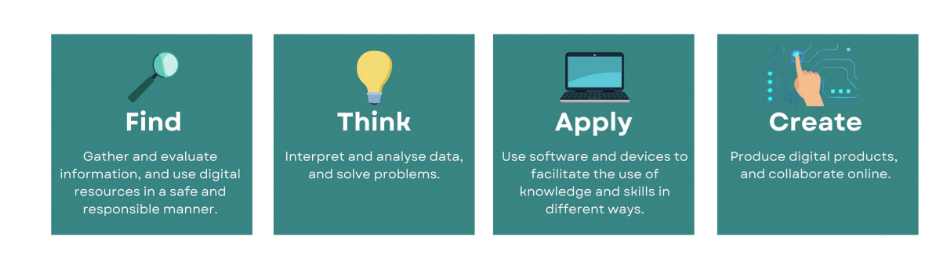
For example, our Primary 1 students learn touch typing skills, learn to operate and navigate in multiple forms of user interface (e.g. SLS). At Primary 2, they learn a higher level of touch-typing skills, and learn skills to locate, collect and sort information (Find) and create a short document (Create). Primary 3 - 6 students acquire the knowledge and skills to search for and evaluate digital information (Find) at a higher level, use information ethically to create or remix digital artefacts, exchange information (Create) and contribute productively in an online community (Create). Relevant digital skills are also infused in Project Work from Primary 2 to 6 so that students can apply and reinforce their learning. For example, students get to apply their search skills and create different digital products using Google Slides, Google Site, Canva, etc.
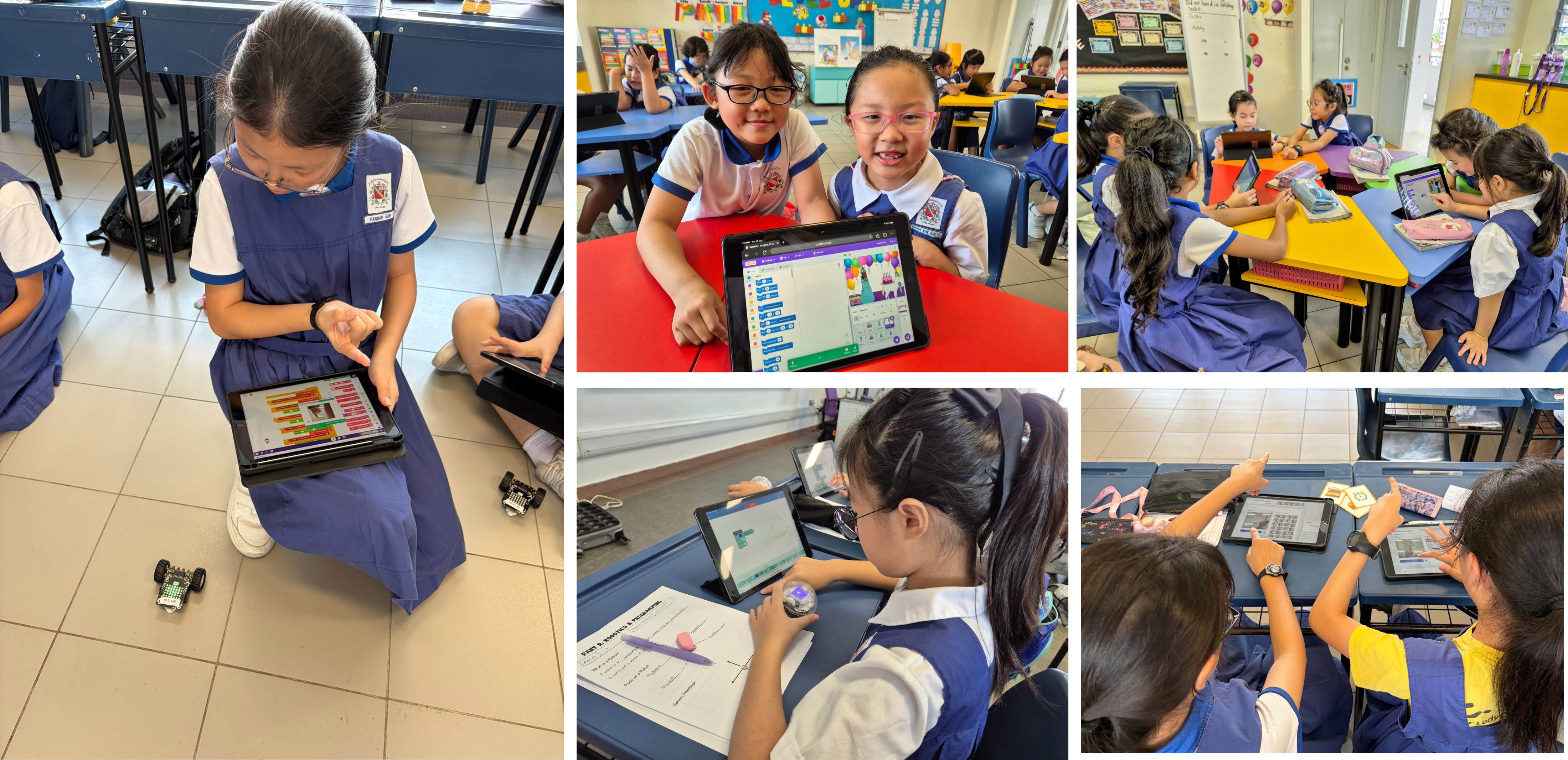
To develop students’ computational thinking for problem solving, all Primary 1 to 6 students learn Coding in our school-based and IMDA’s Code for Fun programmes. These include programming for Scratch, Dash, Sphero, Pictoblox, Teachable Machine, etc which provide opportunities for students to learn more about Artificial Intelligence (AI) to enhance their digital and AI-related skills.